
As concern about the unfolding economic crisis has risen in India, many experts have assured us that 2013 is not 1991.
No longer a discretion of the tax administrator, the audit of returns filed by taxpayers is now based on a selection by algorithms, notes Tarun Bajaj.

'RBI is already late in addressing inflation pressures.'

China's economy, which suffered 6.8 per cent slump in the first quarter due to the coronavirus pandemic -- the worst in 44 years -- bounced back posting 4.9 per cent growth between July and September buoyed by the government's sweeping efforts to stimulate demand and consumption.

Prime Minister Narendra Modi and French President Emmanuel Macron held extensive discussions on a range of bilateral and pressing global issues, including the raging conflict in Ukraine, the situation in the Indo-Pacific and terrorism, as the two top leaders agreed on a blueprint to work together in making the India-France strategic partnership a force for global good.

The sentiment in the real estate industry turned optimistic during October-December 2020 and the outlook for the next six months is positive on the back of revival in demand for both residential and office properties, according to a survey by Knight Frank India-FICCI-Naredco. The 27th edition of 'Real Estate Sentiment Index Q4 2020 survey' of developers, banks, financial institutions and private equity players operating in the sector was released on Monday in a video-conference. As per the report, the 'Current Sentiments Score', for the first time in 2020, entered the optimistic zone at 54 points in Q4 (October-December) 2020, a significant jump of 14 points over the previous quarter.

People are interested in the strength of India's economy, the country's stability, and the opportunities, says Stuart Tait, regional head of commercial banking, Asia-Pacific at HSBC.

S&P Global Ratings on Thursday said the Indian economy is projected to grow at 11 per cent in the current fiscal, but flagged the "substantial" impact of broader lockdowns on the economy. In its report on Asia-Pacific Financial Institutions, S&P said the control of COVID-19 remains a key risk for the economy. New infections have spiked in recent weeks and the country is in the middle of a second pandemic wave.

We have not suffered such huge price shocks across so many basic commodities, at the same time, in decades. Has the inflationary impact of all this been factored into stock prices as yet, asks Debashis Basu.
The Indian Army will not let China change the status quo along the Line of Actual Control (LAC) "unilaterally" and its current deployment along the frontier was not seen before, External Affairs Minister S Jaishankar said on Monday, rejecting Congress leader Rahul Gandhi's criticism of the government's handling of the border row.

'Overtightening of monetary policy by central banks and the spread of new Covid variants, which may force governments to restart lockdowns or restrict mobility.'

'Going ahead, I think the world trade will slow down or decline, and this will be bad for everybody.'
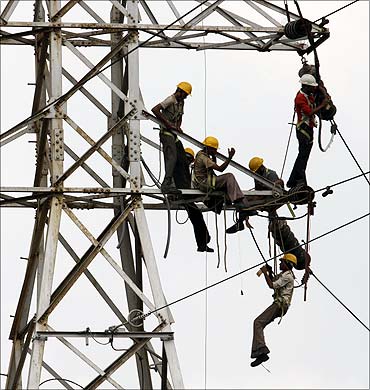
Africa is second only to West Asia as a net exporter of oil.

IMF said in 2017, India is likely to grow at the rate of 7.2 per cent instead of the earlier projected 7.6 per cent.

A gradual increase works best for the US, as well as global markets, says Nizam Idris managing director, head of strategy (fixed income and currencies), Macquarie Bank.

While the collapse of a large financial intermediary can wreak havoc on the system because of the interconnectivity, a large business conglomerate too can play spoilsport if the banks have too much exposure to the entity, explains Tamal Bandyopadhyay.

It had upped India's rating to Baa2 from Baa3 and changed its rating outlook to 'stable' from 'positive', saying the reforms would help stabilise rising levels of debt.
Modi has taken a slew of measures to attract investment, but he has yet to initiate steps that could help repair corporate balance sheets.

Credit rating agencies have been raising red flag over high debt to GDP ratio of India.

Organisations believe that a stable govt will boost their business

The price of bitcoin, the bestselling cryptocurrency, has shrunk nearly three times this year to mark the fate of such digital assets. Crashing prices, regulatory uncertainty and taxes have put Indian crypto exchanges in troubled waters. Finance Minister Nirmala Sitharaman's budget for FY23 announced a 30 per cent tax on any income from the transfer of virtual digital assets.

'It may sound like sacrilege, but does it really matter if the global raters downgrade India for fiscal slippage?' asks Tamal Bandyopadhyay.

'India has entered an economic super-cycle driven by a housing cycle turnaround.'
The land acquisition bill is a catalyst to investment and passing the bill will improve India's business environment.

The growth had slumped to sub-5 per cent in the earlier two consecutive fiscals.

For 2021-22, it projected the economy to clock a growth of 10.6 per cent.

'Kindling the private sector's animal spirits is more important than focusing on how government can give jobs on its own.'

A strong performance by sectors including banking raised the profits of Indian companies by 28 per cent in the three months ended March 2022. The rate of growth is, however, lower than the 30 per cent seen in December. Growth in net sales was also lower than what was seen in the December quarter for the sample under consideration.
Moody's Investors Service on Friday slashed its estimate of India's GDP growth during the 2020 calendar year to 2.5 per cent from an earlier estimate of 5.3 per cent, on account of the rising economic cost of the coronavirus pandemic.

RBI must balance the need for improving domestic bank credit demand and respond to lower inflation.

The market price action seems to point in this direction. Let's hope we finally break out. It is about time! asserts Akash Prakash.

All-out efforts are needed to mitigate the adverse impact of the Covid-19 pandemic, and the RBI will use any instrument necessary to revive growth and preserve financial stability, according to the minutes of the central bank's policy meeting.

'The minimum holding period for equities should be three years.' 'Try goal-based investing.' 'Link your equity portfolios to specific goals such as retirement, purchase of a house or car...'

Attributing the growth to an upswing in consumption and investment, the World Bank has said India will continue to be the fastest growing major economy in the world.

Investing in the US market provides Indian investors a hedge against the rupee's long-term tendency to depreciate against the dollar.

The record breaking spree was led by index heavyweights, financials and metal stocks.

Weaker-than-expected growth in US jobs in recent months had already forced US central bankers to put off a rate hike at their meeting last week

The drop in oil to around $50 a barrel this year has triggered steep cutbacks in production of US shale oil

Indian economy is likely to expand in the range of 5.4 to 5.9 per cent this fiscal, as per government estimates.

Covid-19, US yields, dollar to weigh on equity flows in the near term.
